FIELD NOTE 02 · WRITING / DAILY LIFE
Ostraca: The Reusable Page
Receipts, lists, letters and quick drawings survive because stone flakes and broken pottery were close at hand.
- READING TIME
- 8 minutes
- SECTIONS
- 5
- REVIEWED
- 18 July 2026
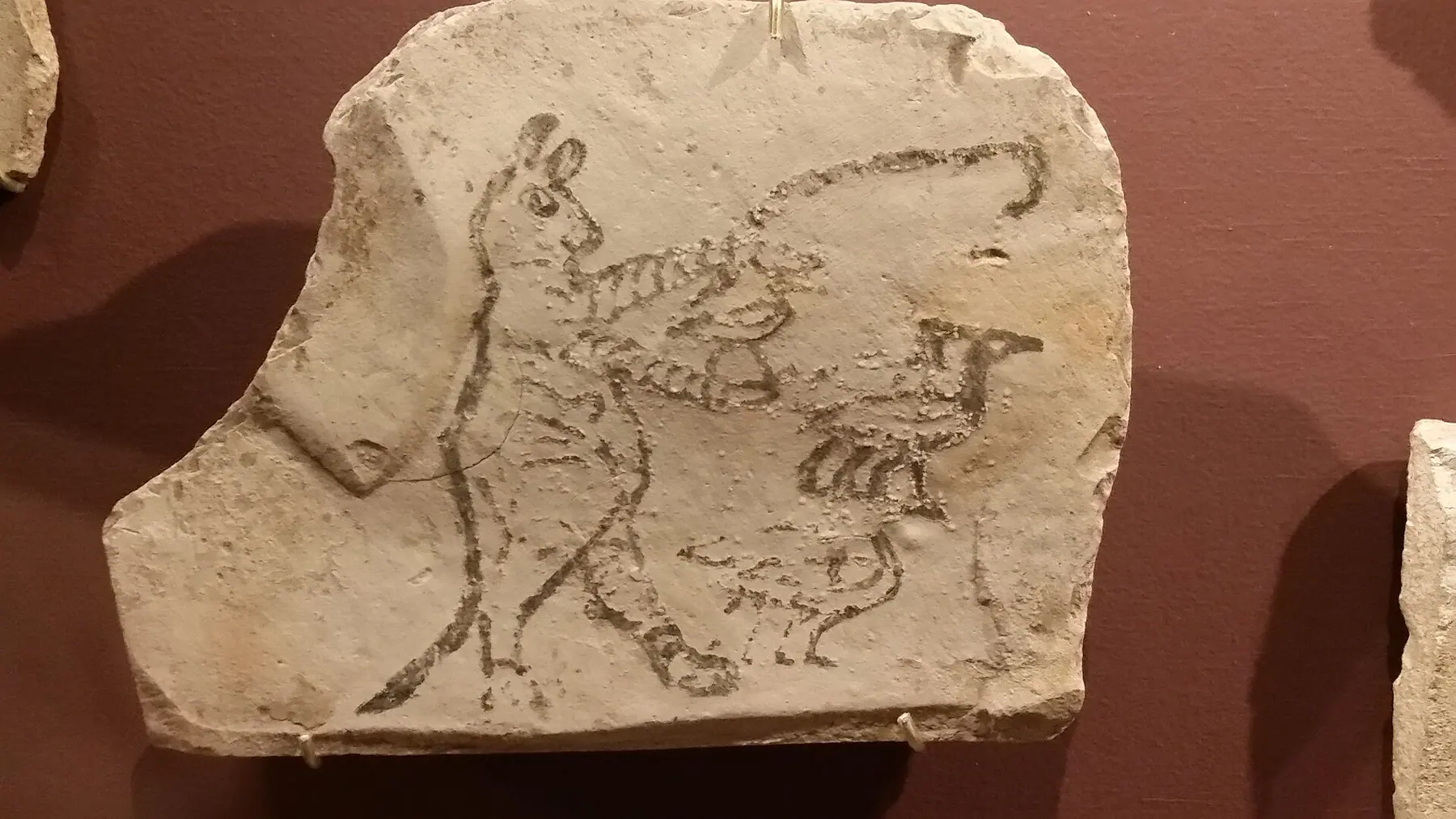
An ostracon is a surface used for writing or drawing, commonly a pottery fragment or flake of limestone. It can carry a formal exercise, a work note, a joke or a sketch—but its informality should not be confused with simplicity.
02.01
Material shaped the message
Papyrus demanded preparation and resources. A smooth limestone flake or broken pot could be used for shorter, temporary or everyday acts of notation. The support influenced size, layout and how much could be written, but it did not determine whether the content mattered.
Cheap material can preserve expensive information.
02.02
A drawing can be work
Animal sketches and lively figures are sometimes described as cartoons. That label may fit their energy, yet the drawing could also be practice, visual thinking, a copy, a joke shared among workers or an unfinished design. Tool marks and repeated lines help reconstruct process without supplying a single certain purpose.
Informal does not mean meaningless, and attractive does not mean decorative.
02.03
Deir el-Medina changed the archive
Thousands of ostraca associated with the community of royal-tomb workers preserve letters, accounts, deliveries, disputes and school exercises. Together they reveal households and labour systems in unusual detail. They are still a partial archive shaped by survival and excavation.
A rich archive can remain socially uneven.
02.04
Translation has visible seams
A translated line depends on reading a hand, expanding abbreviations, identifying vocabulary and choosing modern phrasing. Damage and ambiguity should remain visible through brackets, notes or alternative readings instead of disappearing behind fluent English.
Uncertainty is useful information, not an editorial defect.
02.05
Keep image and record together
A cropped photograph isolates the drawing beautifully but may conceal scale, edge, reverse and museum number. Digital access becomes more useful when an image travels with dimensions, material, provenance, date, transcription, translation and bibliography.
A picture is access; metadata makes it researchable.
STARTING SOURCES
Follow the record.
This note is an editorial introduction, not a catalogue entry. Object-specific identification should be checked against the holding institution’s current record.
- The British Museum — Collection Online
- University College London — Deir el-Medina
- The Metropolitan Museum of Art — Ostraca