FIELD NOTE 03 · PIGMENT / ANALYSIS
How Ancient Colour Is Read
Colour is material evidence: mined, manufactured, mixed, applied, altered and sometimes reconstructed too confidently.
- READING TIME
- 8 minutes
- SECTIONS
- 5
- REVIEWED
- 18 July 2026
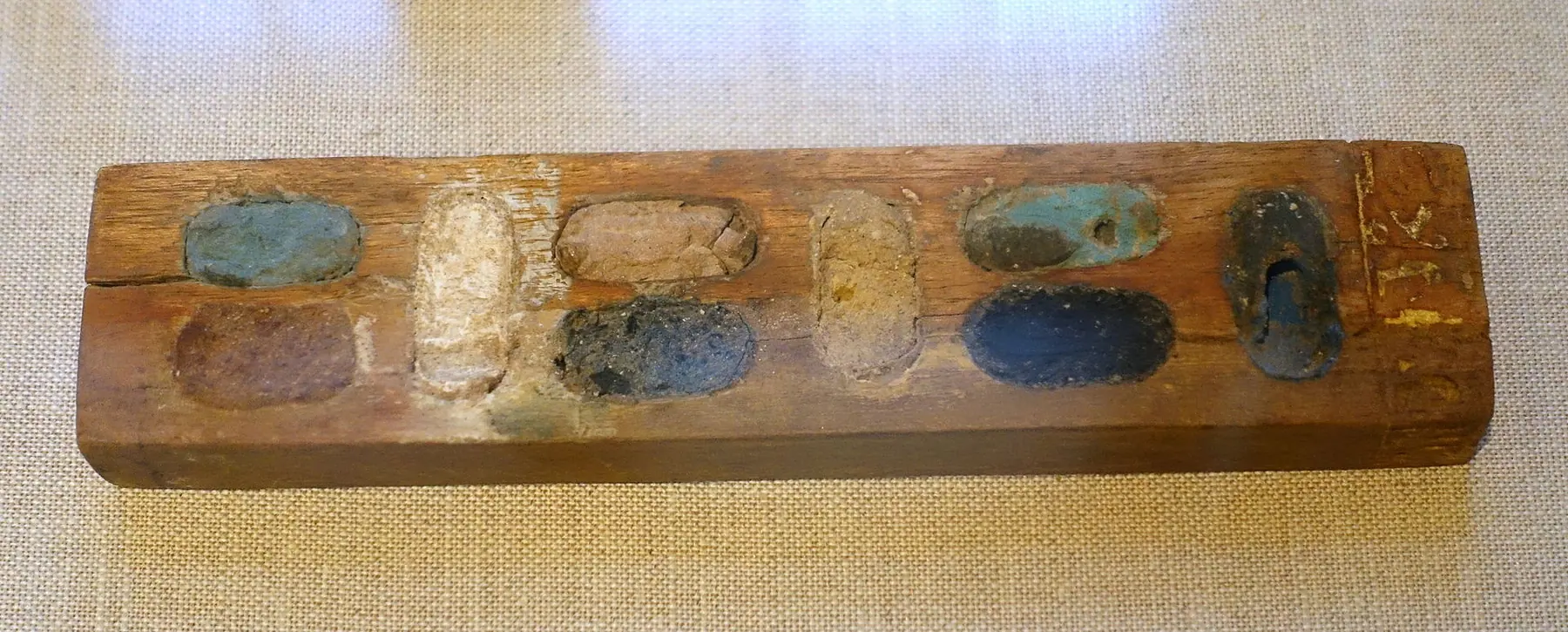
A palette makes colour look neatly separated. On an object, pigments interact with binders, grounds, light, burial and conservation. Reading ancient colour means following that material history.
03.01
Name the layer before the colour
A painted surface may include support, preparation layer, outline, pigment and coating. What appears brown today may be an altered layer rather than the intended colour. Conservators begin by mapping the sequence and condition instead of matching the visible surface to a modern colour chart.
The current appearance is one moment in a long chemical history.
03.02
Blue could be manufactured
Egyptian blue is often described as the earliest synthetic pigment. Its production required silica, a copper source, calcium and controlled heating. That recipe links colour to workshops, fuel, supply and skilled observation—not merely to symbolism.
A pigment is also evidence for technology and organization.
03.03
Analysis should answer a question
Microscopy, X-ray fluorescence, Raman spectroscopy and other methods can identify or constrain materials. No instrument produces context automatically. Sampling decisions, calibration and the limits of a technique belong in the published interpretation.
A scientific result is strongest when its method and uncertainty are legible.
03.04
Digital colour can overpromise
Screens invite saturated reconstructions. A useful reconstruction distinguishes measured evidence from comparison and conjecture, documents the colour-management process and avoids presenting one vivid rendering as a recovered original.
Restoration and reconstruction should announce where evidence ends.
03.05
Preservation changes access
Light, humidity, dust and handling can threaten fragile surfaces. Lower illumination and limited display time may frustrate viewing, but they are evidence-based choices that keep pigment available for future study.
The best view today is not always the best stewardship over time.
STARTING SOURCES
Follow the record.
This note is an editorial introduction, not a catalogue entry. Object-specific identification should be checked against the holding institution’s current record.
- The British Museum — Scientific Research
- The Metropolitan Museum of Art — Materials and Techniques
- UCL Petrie Museum — Collections research